
Picture your living room transformation: that awkward corner finally utilized, your family gathered comfortably for movie night, and every seat offering personalized comfort at the touch of a button. The debate between L-shaped couch recliners and individual recliner chairs isn’t just about furniture—it’s about how you actually live in your space.
Measure your room’s dimensions before falling in love with any option, paying special attention to doorways, traffic flow patterns, and how the reclining mechanisms will extend into your walking areas. An L-shaped reclining sectional typically requires 10-12 feet along two walls plus 3-4 feet of clearance for full recline, while individual recliners give you flexibility to arrange and rearrange as your needs change.
Consider your household dynamics realistically. Families with kids and pets often find L-shaped sectionals create a cohesive gathering spot that withstands daily wear better than separate pieces, while couples or individuals might appreciate the independence of choosing different recliner styles that suit each person’s comfort preferences perfectly.
Calculate the true cost beyond the price tag. That stunning L-shaped recliner might seem expensive upfront, but you’re getting 4-6 seats with built-in functionality. Compare that against purchasing three quality individual recliners plus a connecting sofa, and the sectional often delivers better value per seat while maintaining a streamlined aesthetic that makes smaller rooms feel more spacious rather than cluttered.
What Makes L-Shaped Couch Recliners Different
The Space Conversation: Corner vs. Individual Chairs
Let’s talk about real estate, the kind measured in square feet rather than property taxes. When you’re trying to decide between an L-shaped recliner and a collection of individual reclining chairs, understanding how each option uses your living room space becomes incredibly important.
Here’s the honest truth: an L-shaped reclining sectional typically occupies one corner and follows two perpendicular walls, creating a defined seating zone that leaves the rest of your room open for other furniture or traffic flow. Think of it as anchoring one area while freeing up the rest. Most L-shaped recliners measure somewhere between 100 to 120 inches on the longer side and 80 to 100 inches on the shorter leg, giving you seating for five to seven people in that dedicated footprint.
Now compare that to individual recliner chairs. To seat the same number of people, you’d need four to five separate chairs scattered around your room. Each recliner demands its own clearance zone for reclining, usually 30 to 36 inches behind the chair. When you multiply that space requirement by multiple chairs, you’re suddenly playing Tetris with your floor plan, and the room can start feeling choppy and disconnected.
The corner conversation here really matters because that awkward corner space in most living rooms often becomes wasted real estate with individual furniture pieces. An L-shaped configuration transforms that dead zone into prime seating, essentially giving you bonus capacity without expanding your room’s footprint. You’re working smarter with the space you already have.
For homes where every square foot counts, particularly in apartments or cozy family rooms, that L-shaped design delivers maximum seating without the spatial chaos of multiple recliners competing for elbow room.
Built-In Features That Individual Recliners Can’t Match
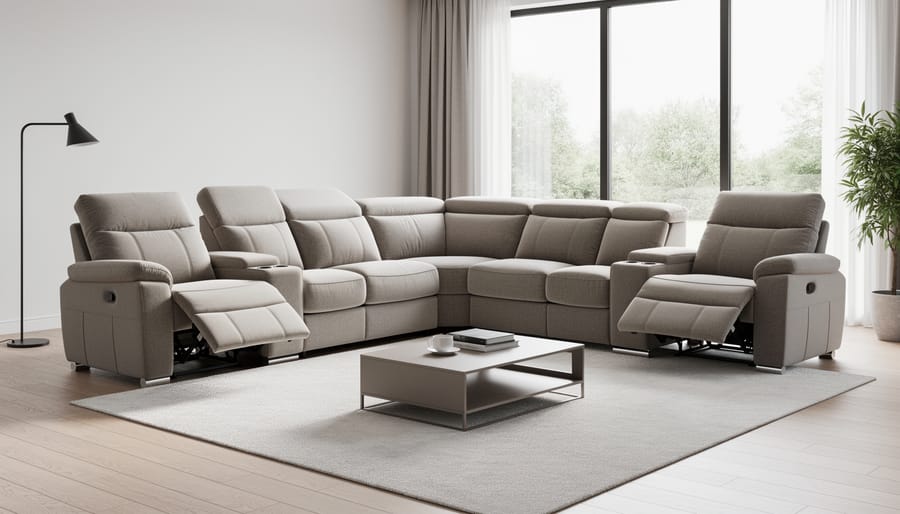
Here’s something individual recliners simply can’t offer: the integrated convenience features that make L-shaped couch recliners so appealing. When you opt for an L-shaped sectional, you’re not just getting seating—you’re getting a full entertainment command center built right into your furniture.
Many modern L-shaped reclining sofa options come with center consoles that house storage compartments perfect for stashing remote controls, magazines, or cozy throw blankets. These consoles often feature built-in cupholders that keep your beverages secure and within arm’s reach—no more balancing mugs on armrests or hunting for side tables.
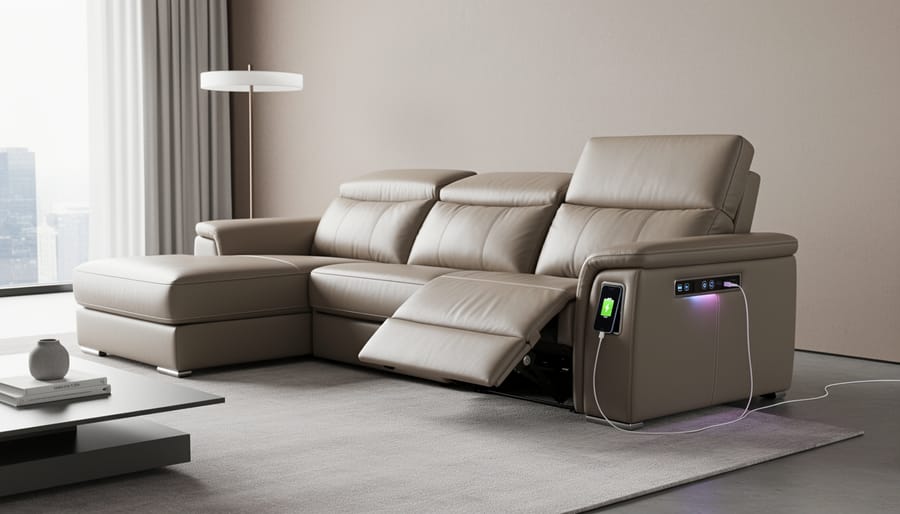
But here’s where it gets really exciting: USB charging ports and power outlets. Imagine settling in for movie night and being able to charge your phone or tablet without leaving your seat. Some premium models even include wireless charging pads and LED lighting for added ambiance.
The beauty of these features in an L-shaped design is their strategic placement. Everything is positioned exactly where you need it, flowing naturally with the sectional’s layout. With individual recliners, you’d need to purchase separate console tables or side tables to achieve similar functionality, creating a cluttered look and eating up more floor space.
Additionally, many L-shaped sectionals feature hidden storage compartments under seats—perfect for extra pillows, blankets, or kid-friendly items. This integrated approach transforms your living room into a streamlined, functional space that individual pieces simply can’t replicate without additional furniture investments.
Comfort Comparison: One Big Piece vs. Multiple Chairs
Reclining Mechanisms: What Works Best
When shopping for an L-shaped couch recliner, the mechanism you choose can make or break your relaxation experience. Let’s explore your options so you can find the perfect fit for your lifestyle and budget.
Manual recliners operate with a simple lever or push-back system. They’re the tried-and-true option that many homeowners appreciate for their reliability and lower price point. There’s something satisfying about physically adjusting your position without worrying about electrical components or power sources. The downside? You’ll need a bit of physical effort to operate them, which might be challenging for family members with mobility concerns. Plus, you’re working with preset positions rather than infinite adjustability.
Power recliners bring modern convenience to your sectional experience. With just the touch of a button, you can glide smoothly into your ideal position. Many models offer independent footrest and backrest controls, letting you customize your comfort down to the degree. The debate around power versus manual recliners often comes down to budget and preference, since power options typically cost more and require proximity to electrical outlets. However, they’re fantastic for anyone who values effortless adjustment or needs accessibility features.
Zero-gravity recliners represent the premium tier, distributing your weight evenly to reduce pressure points and create that floating sensation astronauts experience. These mechanisms work beautifully in L-shaped configurations, particularly in the corner seat where you might spend the most time unwinding after long days.
Consider how you’ll actually use your sectional. Movie marathons might call for power convenience, while budget-conscious buyers might find manual mechanisms perfectly adequate for occasional lounging.
The Family Movie Night Test
Picture this: It’s Friday night, the popcorn’s ready, and everyone’s gathering for the latest superhero blockbuster. This is where the real difference between L-shaped recliners and individual chairs becomes crystal clear.
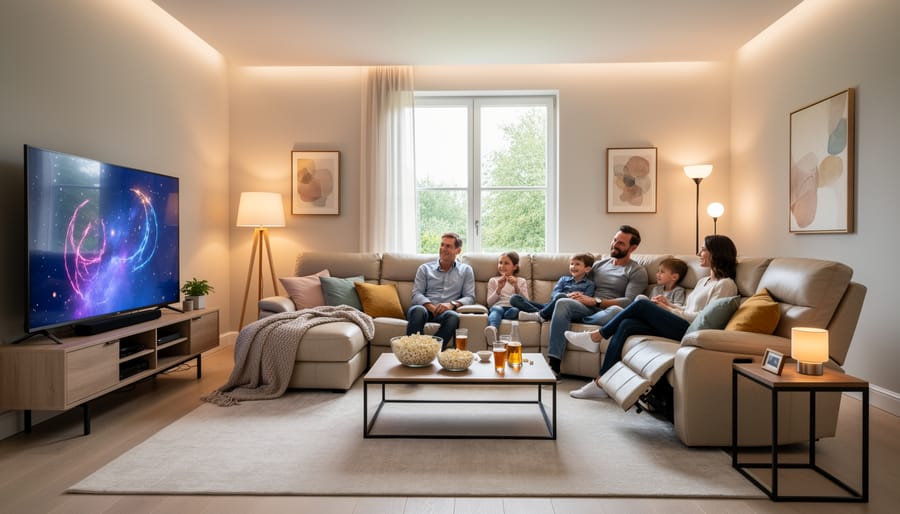
With an L-shaped recliner sectional, your family naturally congregates in one cohesive space. Kids can sprawl across one section while adults claim the corner spot, and there’s still room for someone to squeeze in with a bowl of snacks. The continuous seating means no one feels isolated or stuck in “their” designated chair. Plus, sharing blankets becomes effortless when everyone’s connected on the same piece of furniture.
Individual recliners, on the other hand, create distinct territories. Each person gets their own command center with personalized controls, which sounds great until you realize your daughter can’t quite reach the coffee table from her chair, and your son keeps reclining so far back he disappears from view. The gaps between chairs also become accidental snack traps and phone graveyards.
During game nights or casual conversations, the L-shaped configuration encourages interaction. Everyone can see each other without awkward chair repositioning. Individual recliners work better for households where everyone has different schedules and preferences, but they lack that communal gathering vibe.
The verdict? If togetherness tops your priority list and you regularly host family activities, the L-shaped recliner creates that welcoming, connected atmosphere that transforms ordinary evenings into memorable moments. Individual chairs excel for independent relaxation but miss the magic of shared experiences.
Price Point Reality Check
Let’s talk numbers, because understanding the real cost differences can make or break your furniture decision. At first glance, individual recliners might seem like the budget-friendly route, but the math tells a more interesting story.
A quality individual recliner typically runs between $400 and $1,200, depending on features and materials. If you’re furnishing a living room with three separate recliners to accommodate your family, you’re looking at anywhere from $1,200 to $3,600. Meanwhile, a decent L-shaped reclining sectional starts around $1,500 and can stretch to $4,000 or more for premium options. The initial investment might feel steeper, but here’s where it gets interesting.
When you buy a sectional, you’re getting a cohesive piece that includes the connectors, matching upholstery, and a unified design aesthetic. With individual chairs, you might think you’re saving money, but consider the hidden costs. You’ll need side tables between each chair, potentially more floor lamps for adequate lighting, and probably some throw pillows to tie everything together visually. These extras add up faster than you’d expect.
The long-term value equation shifts even more in favor of sectionals. A well-constructed L-shaped recliner is built as one continuous piece with reinforced joints and integrated mechanisms. Individual recliners, especially budget models, often require replacement or repairs within five to seven years. Think about it like this: replacing one recliner in a set of three disrupts your whole room’s look, while a sectional maintains its appearance and functionality for a decade or more with proper care.
There’s also the resale consideration. Sectionals hold their value better and appeal to a broader market when it’s time to upgrade. Individual recliners are harder to sell as a matching set, and buyers often want just one piece, not three.
The bottom line? If you’re planning to stay put for a while and value cohesive design, the sectional often delivers better bang for your buck over time.
Room Layout Challenges (And Solutions)
Small Living Rooms: The Surprising Winner
Here’s something that might surprise you: L-shaped couch recliners can actually be your best friend in a small living room. I know, it sounds backwards, right? You’d think cramming a big sectional into a tight space would be a disaster, but hear me out.
When you opt for multiple individual recliners, you’re dealing with awkward gaps between chairs, wasted corner space, and a choppy furniture arrangement that makes your room feel even smaller. An L-shaped recliner, on the other hand, nestles perfectly into corners and creates one continuous seating flow. This visual unity tricks the eye into seeing more space, not less.
Think about the math too. Two or three separate recliners for compact spaces need clearance room behind each one for reclining, plus walking paths around each chair. That’s a lot of dead space eaten up. A sectional recliner consolidates all that clearance into one zone, freeing up more usable floor area.
I’ve seen countless small living rooms transformed by this exact switch. One homeowner swapped three bulky recliners for a compact L-shaped sectional and suddenly had room for a bookshelf and side table they’d been dreaming about. The key is choosing a streamlined model without oversized armrests or excessive padding.
The secret isn’t about furniture size, it’s about smart furniture placement. Sometimes the bigger piece is actually the smarter choice.
Lifestyle Fit: Which Option Matches Your Home
Choosing between an L-shaped reclining sectional and individual recliners really comes down to how you live in your space day-to-day. Let’s walk through some real-world scenarios to help you figure out which option feels right for your home.
If you have a busy household with kids, pets, or frequent movie nights with the whole family, an L-shaped recliner sectional often wins out. These sectionals create a cozy gathering spot where everyone can sit together without feeling cramped. Picture this: game day arrives, you’ve got snacks ready, and your L-shaped sectional accommodates six people comfortably, all with optimal viewing angles to the TV. Individual recliners would require more strategic placement and might leave some guests facing awkward directions.
For couples or smaller households who value flexibility, individual recliners might be your sweet spot. You can rearrange them easily, face them toward different focal points, or even move one to another room when you redecorate. This adaptability becomes especially handy when you’re exploring furniture colors for gray walls or refreshing your design scheme.
Consider your entertaining style too. Do you host large gatherings where people naturally congregate in the living room? An L-shaped sectional provides that welcoming, conversation-friendly setup. But if you prefer intimate gatherings or need seating that can easily shift between different activities like reading, watching TV, or chatting, separate recliners offer that versatility.
Think about your design preferences as well. L-shaped sectionals make a bold statement and anchor your room with cohesive style. They work beautifully in open-concept spaces where defining the living area matters. Individual recliners, meanwhile, give you freedom to mix styles, textures, and even colors if you’re feeling adventurous.
Finally, consider future flexibility. Planning to move in a few years? Individual recliners adapt to new floor plans more easily. Settling into your forever home? That L-shaped sectional investment might be exactly what transforms your living room into the ultimate comfort zone your family will enjoy for years to come.
What to Look for When Shopping
Before you fall in love with that gorgeous L-shaped recliner sectional or start filling your cart with individual recliners, let’s talk about the nitty-gritty details that separate amazing purchases from buyer’s remorse. After all, avoiding common furniture buying mistakes starts with knowing what to examine before you commit.
First up, test those reclining mechanisms like your comfort depends on it, because it absolutely does. Whether you’re checking out a sectional or standalone chairs, activate every recliner multiple times. Listen for smooth, quiet operation rather than grinding or clicking sounds. Manual levers should feel sturdy and easy to reach without awkward stretching, while power buttons should respond instantly. If the store has floor models, ask how long they’ve been there and inspect them for wear patterns that reveal durability issues.
Frame construction matters more than you might think. Peek underneath or ask about the frame material. Hardwood frames, especially kiln-dried hardwood, will outlast particle board or softwood alternatives by years. For sectionals, examine how the pieces connect. Are they just pushed together, or do they use secure brackets and clips? A wobbly connection today becomes a frustrating gap tomorrow.
Upholstery quality deserves serious attention too. Run your hands across the fabric or leather, checking for consistent texture and tight stitching. Double-stitched seams hold up better to family life. If you have kids or pets, consider performance fabrics that resist stains and wear. For leather options, top-grain and full-grain varieties age beautifully while bonded leather tends to peel over time.
Don’t forget the practical stuff. Measure doorways, stairwells, and hallways leading to your living room. Many sectionals come in pieces, but confirm delivery logistics beforehand. Check the weight capacity per seat, especially if you have larger family members. Finally, understand the warranty coverage for both the frame and the reclining mechanism, as these protect your investment long-term.
At the end of the day, choosing between an L-shaped couch recliner and individual recliners comes down to understanding your space, your lifestyle, and what truly makes you comfortable. There’s no one-size-fits-all answer here, and that’s actually good news because it means you get to customize your living room exactly the way you want it.
If you love gathering the whole family for movie marathons and have the square footage to spare, an L-shaped reclining sectional creates that cozy, cohesive vibe that brings everyone together. On the flip side, if flexibility matters more to you, or you’re working with a smaller or awkwardly shaped room, individual recliners give you the freedom to rearrange whenever inspiration strikes.
Don’t get swept up in what’s trending on social media or what your neighbor just bought. The best furniture investment is the one that serves your daily life, fits your actual space, and still makes you smile when you walk into the room three years from now. Sit in different options if you can, measure twice, and trust your instincts. Your living room should work for you, not the other way around.